Railway
★ Editor's PickDeploy anything with one click.
Grow your DR (guaranteed) & Rank on Google, ChatGPT, and Claude
🚀 DR Boost — £199
5× dofollow backlinks from DR 20–70 sites
⚡ DR Mega Boost — £279 Best value
10× dofollow backlinks — 30% cheaper per link
Quick summary of Railway
Railway is a cloud deployment platform for full-stack applications, founded in 2020 by Jake Cooper. It's positioned as the modern alternative to Heroku, focused on backend and full-stack apps (where Vercel focuses on frontends). Core features: git-based deploys, one-click managed Postgres / MySQL / Redis / MongoDB, custom domains, secrets management, automatic builds, pay-as-you-go usage-based pricing, and a CLI for terminal-based deploys. Best for indie founders and small teams building backend services, full-stack SaaS, and side projects who want a Heroku-like experience without Heroku's pricing. Trial gives $5 of one-time usage; Hobby is $5/month minimum with usage on top; Pro is $20/user/month. Direct competitors: Render (predictable per-service pricing), Fly.io (global edge deployment), Heroku (legacy default), DigitalOcean App Platform (cheaper but less polished), Northflank (more enterprise-leaning). Railway wins on indie-founder DX and pricing model; Render wins on price predictability; Fly wins on global edge deployment.
⏱ 30-second verdict
- Deploys backend and databases as easily as Vercel deploys frontends
- Pay-as-you-go pricing, no surprise bills
- Trial is one-time only, must commit to $5/mo to test seriously
About
Heroku-style platform for full-stack apps. Run Node, Python, Postgres, Redis, cron jobs, and background workers — all in one project with sane defaults.
🎯 Why it's useful
When Vercel's serverless model doesn't fit (long jobs, websockets, persistent processes), Railway is the cheapest grown-up option.
💜 Our take
Tiny Startups runs on Railway. The dashboard is the prettiest of any deploy platform.
Key Features
Integrations
✓ Best for
Full-stack developers and indie founders who want Heroku-like simplicity without the cost. Perfect for startups deploying Node, Python, or Go apps that need databases and background jobs in one place.
✗ Not ideal for
Teams requiring extensive on-premise control or highly specialized infrastructure. Not ideal for applications with extreme scale needs or those requiring deep Kubernetes customization.
How indie founders use Railway
Full-stack SaaS hosting
Next.js plus Postgres plus Redis plus worker process in one Railway project. One dashboard, one bill, one git connection.
Managed Postgres
One-click Postgres with automatic backups and a connection string. Cheaper than dedicated providers like Neon or Supabase at low scale.
Background workers and cron
Long-running workers and scheduled jobs are first-class. Better than trying to wedge cron jobs into Vercel functions.
Side-project experiments
The $5/mo pay-as-you-go model means a sleeping side project costs almost nothing. Ship a weekend project, leave it running for a year.
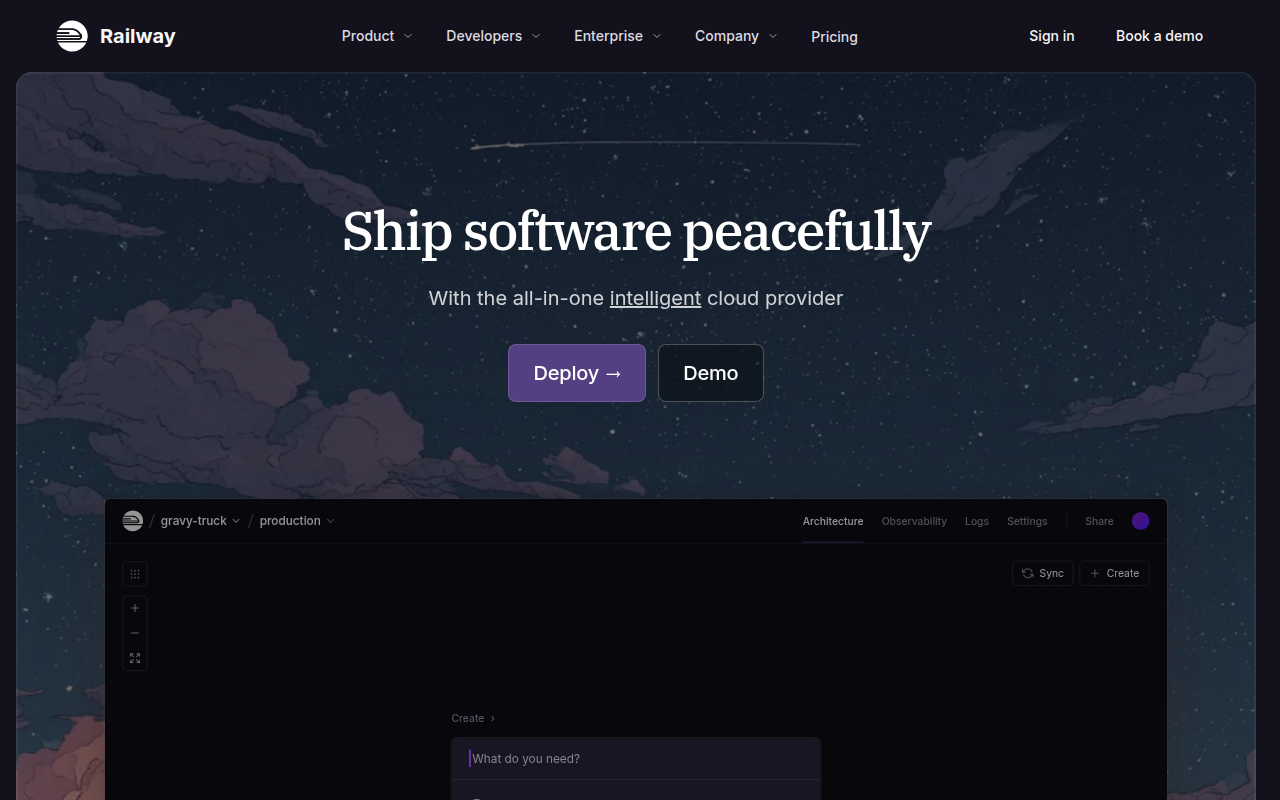
Railway is what Heroku should have become if it hadn't been stuck in 2015. If you need a backend deployment platform with a real database, real workers, real cron jobs, and no surprise bills, this is the one. I run a bunch of side projects and small SaaS on Railway and the experience is just clean. The setup is uneventful in the best way. Connect a GitHub repo. Railway detects your language, builds it, deploys it on a public URL. Need Postgres? One click. Need Redis? One click. Need a second service in the same project (maybe a worker, a cron job, or a separate API)? One click. The whole experience feels like Vercel for full-stack apps. The pricing model is honest. Pay-as-you-go on CPU plus memory plus bandwidth, with a $5 monthly minimum on the paid tier. Usage is visible in the dashboard so there are no surprise bills. The Trial gives you $5 of one-time usage; after that it's Hobby at $5/month plus actual consumption. A typical small SaaS runs $15-30/month all-in. Compare that to Heroku, where the same setup is $50+ just for dynos. The killer dev-loop feature is the CLI. railway up deploys from your terminal. railway logs streams logs from your services. railway run executes commands with your production env vars. It's a proper Heroku-CLI-quality experience but for 2026. Postgres backups are automatic. Custom domains work in 30 seconds. Cron jobs are first-class. Everything you'd want from a modern deploy platform. Where Railway falls short: cold starts on rarely-used services can be slow (under-provisioned services sleep). The free trial is one-time only, which means you have to commit to $5/month to genuinely evaluate it for more than a few hours. Some niche stacks (Crystal, Nim) need a custom Dockerfile. For 95% of indie SaaS backend stacks, Railway is the obvious modern choice. If you're on Next.js, host frontend on Vercel and your DB/workers on Railway. If you're on a full-stack framework (Rails, Phoenix, Django), Railway can host everything. Either way, recommended.
Pricing
Trial
- ✓$5 of free usage
- ✓Single environment
- ✓No custom domains
- ✓Public projects only
Hobby
- ✓$5 credit included
- ✓Custom domains
- ✓Pay-as-you-go for CPU/RAM/bandwidth
- ✓Postgres backups
Pro
- ✓Everything in Hobby
- ✓Team access + roles
- ✓Priority builds
- ✓$20 credit included
Free tier with $5 credit/month · Pay-as-you-go starting ~$5/month · Enterprise pricing available
Frequently asked questions
Is Railway free?
There's a one-time $5 free trial, then it's $5/month minimum on Hobby (includes $5 of usage credits). Pro is $20/user/month minimum. No truly-free tier exists. Railway is paid-only after the trial.
Railway vs Render vs Fly.io, which should I pick?
Railway for the smoothest indie-founder DX and pay-as-you-go pricing. Render for predictable monthly pricing per service ($7/instance and up). Fly.io for global edge deployment and Postgres-on-edge. All three are good Heroku alternatives. Railway has the best Next.js plus backend combo.
Can I host a Next.js app on Railway?
Yes. Railway detects Next.js, builds it, and serves it. You miss some Vercel-specific optimisations (edge functions, image optimisation) but gain the ability to run a real Postgres in the same project. Many indie SaaS host their full stack on Railway.
What databases does Railway support?
Postgres, MySQL, Redis, and MongoDB are first-class one-click adds. Volumes (persistent disk) let you self-host other databases. Postgres includes automatic backups.
Railway vs Heroku, what's the difference?
Railway is the modern indie-friendly Heroku. Same git-push-to-deploy ethos, similar plugin model, but with current pricing, modern UI, fast builds, and a community that hasn't aged out. Heroku is still solid but expensive at $7+/dyno and feels stuck in 2015.
Reviews
No reviews yet — be the first.
Tools like Railway
See all Developer Tools →Supabase
The open-source Firebase alternative.
Resend
Email API for developers, finally good.
Vercel
Frontend cloud built for Next.js.
GitHub
The home of code on the internet.
Nova
AI-powered code editor built natively for macOS developers.
Octopus
Visual sitemap builder and website planner for rapid prototyping.