GitHub
★ Editor's PickThe home of code on the internet.
Grow your DR (guaranteed) & Rank on Google, ChatGPT, and Claude
🚀 DR Boost — £199
5× dofollow backlinks from DR 20–70 sites
⚡ DR Mega Boost — £279 Best value
10× dofollow backlinks — 30% cheaper per link
Quick summary of GitHub
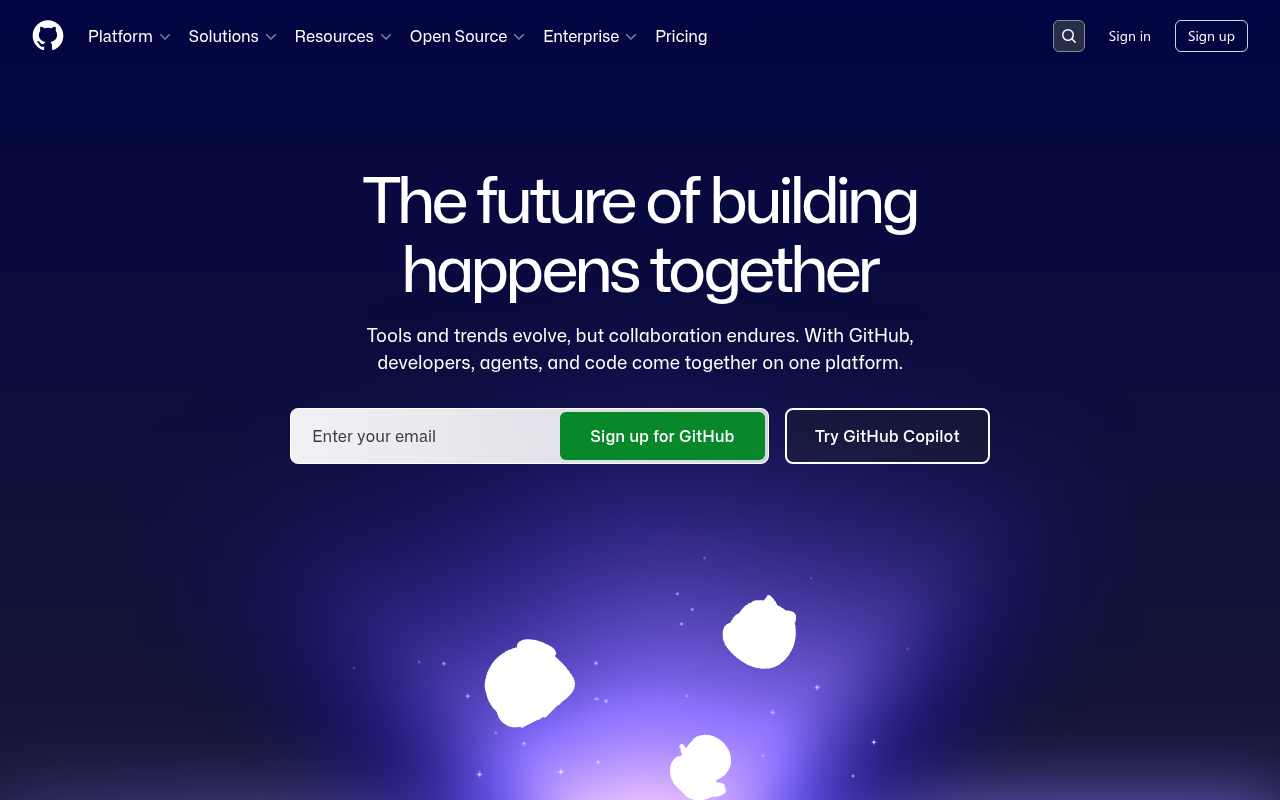
GitHub is the world's largest software development platform, owned by Microsoft since 2018, hosting over 100 million developers and 400 million repositories. Originally a code-hosting service, it now spans the full software lifecycle: version control (Git), code review (Pull Requests), CI/CD (Actions), package hosting (Packages), project management (Projects + Issues), security scanning (Dependabot, Advanced Security), and AI pair programming (Copilot). Best for indie founders, open-source maintainers, and software teams of every size. The Free tier covers unlimited public and private repos plus 2000 Actions minutes/month — enough for most solo developers. Team is $4/user/month, Enterprise $21/user/month. Direct competitors: GitLab (self-hostable, more DevOps bundled), Bitbucket (Atlassian ecosystem), Codeberg / Gitea (open-source self-hosted). GitHub wins on ecosystem gravity, Copilot, and integrations; GitLab wins on bundled DevOps and self-hosting.
⏱ 30-second verdict
- Free tier covers solo and small-team indie work for years
- Copilot autocomplete saves 30%+ of typing time
- Projects boards feel dated next to Linear or Notion
About
Source-code hosting, pull requests, code review, CI via Actions, package registry, and increasingly, AI features (Copilot, Workspace).
🎯 Why it's useful
Free for private repos. Actions usage is generous enough that small teams never see a bill.
💜 Our take
The breadth of integrations — every dev tool worth using talks to GitHub. Single source of truth.
Key Features
Integrations
✓ Best for
Solo developers and teams of any size who need a centralized platform for version control, collaboration, and automation. Especially valuable for open-source maintainers and startups wanting built-in CI/CD without external services.
✗ Not ideal for
Teams requiring on-premise-only solutions due to compliance constraints, or organizations already heavily invested in alternative Git platforms like GitLab who need self-hosted options.
How indie founders use GitHub
Source code and version control
Where your code actually lives. Branches, pull requests, code review, history. The default and there's no good reason to look elsewhere.
Copilot AI pair programming
Inline AI autocomplete in your editor, plus chat that knows your repo. Worth the $10 a month for any working developer.
CI/CD via Actions
Run tests, build images, deploy on push. The 2000 free Actions minutes per month covers most indie projects. YAML config is fiddly but ubiquitous.
Open-source distribution
Open-source a tool you built for your SaaS. Free marketing, credibility, recruiting funnel. The single highest-leverage indie founder move.
Calling GitHub a 'tool' undersells it. It's the substrate of modern software. Your code lives there. Your issues, your CI, your packages, your project boards, your AI pair programmer, your security scanning, all on the same platform. And it's priced reasonably enough that an indie founder can fund themselves on the free tier indefinitely. What matters for indie founders specifically: GitHub is your public resume. Your commits are visible. Your contributions to other projects are visible. Investors, customers, and potential hires can verify you're a builder in seconds. Open-sourcing something you built alongside your SaaS is one of the highest-leverage moves an indie can make. Instant credibility, organic search traffic for years, and a recruiting funnel that costs nothing. The Free tier is honestly enough for most solo founders. Unlimited public and private repos, GitHub Pages for static sites, 2000 free Actions minutes per month, Copilot for $10/month, basic Projects boards. The $4/user Team plan adds branch protections and required reviewers. You don't need Enterprise until you have an actual enterprise. Copilot is now part of the muscle memory of writing code. Disabling it feels like coding with one hand. Copilot Chat in the editor handles 'why is this broken' moments faster than Stack Overflow. Code review with Copilot has gotten genuinely useful for first-pass PR feedback. Worth the $10/month for any working developer. Where GitHub feels dated: Projects (their Linear/Trello alternative) is competent but slow. Discussions never quite reached the engagement of Discord. And Actions is powerful but the YAML config is fiddly enough that you'll often paste it into ChatGPT to debug. None of that matters. GitHub is where code lives. You're using it. Lean into the social side too: pin your best repos, write proper READMEs, ship one open-source utility per year. The compounding effect on your reputation over time is real.
Pricing
Free
- ✓Unlimited public + private repos
- ✓2000 Actions minutes/mo
- ✓500MB Packages storage
- ✓Community support
Team
- ✓3000 Actions minutes
- ✓2GB Packages storage
- ✓Required reviewers
- ✓Code owners
- ✓Branch protections
Enterprise
- ✓SAML SSO
- ✓SOC 2 + audit log
- ✓GitHub Advanced Security
- ✓50000 Actions minutes
- ✓24/7 support
Free (public repos, basic features) · Pro $13/mo · Team $231/mo (5-person minimum) · Enterprise custom pricing
Frequently asked questions
Is GitHub free?
Yes. The Free tier includes unlimited public and private repos, 2000 Actions minutes per month, and most collaboration features. Team at $4/user/month adds required reviewers and branch protections. Enterprise adds SAML SSO and audit logs.
GitHub vs GitLab, which should I pick?
GitHub if you want the larger ecosystem, more polished UI, and Copilot's AI features. GitLab if you want a self-hosted option, more built-in DevOps, or all-in-one bundling at scale. Most indie founders pick GitHub by default. The gravity is overwhelming.
Is GitHub Copilot worth $10/month?
Yes for almost every working developer. The autocomplete saves real time, the chat is good for quick questions, and Copilot in PR reviews catches obvious mistakes. The free Copilot tier (50 chats + 2000 completions/month) is also enough to try it.
Can I host static sites on GitHub Pages?
Yes. GitHub Pages is free for public repos and supports custom domains with free SSL. Best for documentation, personal sites, project landing pages. Use Vercel or Netlify if you need server-side rendering or serverless functions.
Does GitHub work for non-code projects?
Increasingly yes. People version-control writing, recipes, contracts, even datasets. Projects boards and Issues are usable as a lightweight task tracker. But if it's not code, Notion or Linear is usually a better fit.
Reviews
No reviews yet — be the first.
Tools like GitHub
See all Developer Tools →Supabase
The open-source Firebase alternative.
Resend
Email API for developers, finally good.
Vercel
Frontend cloud built for Next.js.
Railway
Deploy anything with one click.
Nova
AI-powered code editor built natively for macOS developers.
Octopus
Visual sitemap builder and website planner for rapid prototyping.